
I have a friend, Dr. Gulnur, Head of the Faculty of Language and Culture at Naberezhnye Chelny State Pedagogical University, a university in the Kazan region of Russia. In 2025 I travelled to NCSPU for a conference and was received with extraordinary warmth by colleagues there. So in August 2026, when Gulnur came to HUFLIT as a keynote speaker at an international conference, I wanted to offer my friend from afar a truly special experience in Vietnam.
After the conference, I asked her: “Dr. Gulnur, you have two choices: go to the beach in Phan Thiết, or take an adventure into the primary tropical forest near my farm?”
She hardly needed to think. “I have travelled to many places and seen many beautiful beaches. But I have never seen a tropical forest. I choose the forest.”
And so a journey began. None of us imagined that in only two short days we would enter the forest twice—two forests, two completely different feelings—and that when we returned, the memory of the great forest would become the deepest part of the entire trip.
From a Promise to the Forest
At six o’clock on Saturday morning, 8 August 2026, my family, the family of Mr. Tuấn from HUFLIT, and Gulnur left Ho Chi Minh City.
On the way to Thiên Ưng Phủ we stopped at Phật Quốc Vạn Thành Pagoda. The grounds are extensive, with many areas to visit, but because time was limited we went only into the main hall below the giant Maitreya statue and visited Phổ Đà Sơn, where 34 Guanyin statues are shown in 34 different meditation postures.

The solid-porcelain statues, vividly rendered within a silent space, fascinated Gulnur. She moved from one to another, continually asking about the meaning of each posture.
At about 12:30, we arrived at Thiên Ưng Phủ. A forest shower had just passed.
Cool wind rose from the lake. The earth was still wet. The air carried faint scents of ginger, galangal, đinh lăng and vegetation after rain. The retreat houses on both sides of the lake reflected in the quiet water. It was the kind of landscape that made you want to step outside the moment you put down your luggage.
Tuấn could not even wait. The newly bought kayak was inflated, and a short while later he was already paddling in the middle of the lake. But the day’s real adventure was still ahead.
First Entry into the Forest: Only Ten Minutes Across the Lake
At four in the afternoon, a barge belonging to Uncle Út Len pulled up at the landing in front of the retreat. Everyone put on life jackets, hats and rain gear, then climbed aboard.

As the barge slowly left the shore and rounded the Thiên Ưng Phủ peninsula, Gulnur looked at the broad lake and the bands of forest in the distance and said, “This is a very expensive experience.”
We understood what she meant. In many parts of the world, sitting in a place with almost no traffic noise, no high-rise buildings, no crowds—only water, sky and near-pristine forest—can cost a great deal of money.
Tuấn nodded. “Yes. It is expensive in some ways.”
Only about ten minutes later, the barge reached the opposite bank. Before us stood strictly protected primary forest.
Phương, the caretaker of Thiên Ưng Phủ, jumped ashore first. The vegetation was so dense that he had to pull branches down by hand to let everyone squeeze through. We followed one another inside.
After only a few dozen metres, the light from the lake behind us had almost vanished. Inside the forest was another world.
Large and small trunks crowded together. Vines stretched from branch to branch. Fallen leaves lay thick underfoot, soft and damp. After the rain, water still clung to the foliage; every time someone brushed a branch, droplets pattered onto our shoulders.
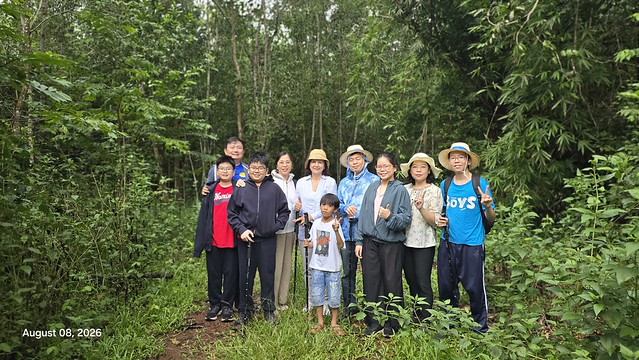
Then the mushrooms began to appear. They grew on dead trunks, in leaf litter and beside moss-covered roots. Some resembled lingzhi, some formed white clusters like snow fungus, and some were round as eggs just emerging from the earth. The children immediately forgot that they had been afraid of the forest.
“Can we eat this mushroom?” “What about that one?”
Tuấn put on a serious face for a second and said, “If you eat this one, you’ll sleep very well. You’ll sleep forever!”
Everyone burst out laughing. But the joke also reminded the children of an important rule: in the forest, if you do not know what something is, do not touch it casually, and certainly do not pick it or taste it.
We went on. The forest grew denser. Conversation gradually faded. At times there was only the snap of a dry branch underfoot, the sound of insects and leaves rustling somewhere out of sight.
Then the ants appeared. Gulnur was bitten. The children began to complain as well. Someone looked back. The lake was no longer visible.
“Should we turn back?”
Everyone agreed. We retraced the way we had come. But only a few minutes later, an uneasy feeling began to spread. No one could recognise the old route.
The group stopped. Phương looked around. His face began to tense. Nobody joked anymore.
In that moment I understood very clearly something that seems obvious: primary forest can disorient a person astonishingly quickly.
We had not gone far. But if we kept choosing the wrong direction, even a few hundred metres in the forest could become a serious problem.
Someone shouted toward the direction we thought the lake might be: “Mỹ ơi!”
No answer. The forest swallowed voices very quickly. We called again, louder: “MỸ ƠI!”
A few seconds of silence. Then, very far away through layers of trees, a voice came back: “ƠI!”
Almost the whole group cried at once: “Thank goodness!”
We immediately moved toward the answering voice. A patch of brightness began to appear between the trunks. Then the water came into view. The barge was still there. When we reached the bank, everyone breathed out in relief.
Our little plan to “go in just far enough to see what the forest is like” had suddenly become an unforgettable lesson. The forest lay directly across the lake, only ten minutes by boat from where we were sleeping. Yet the instant we crossed its edge, we were no longer in the familiar human world.
A Night beneath the Sky of Thiên Ưng Phủ
That evening, after our frightening episode, everyone returned in a strangely exhilarated mood. The gala dinner opened with a bilingual Russian–Vietnamese speech by Mr. Tuấn.
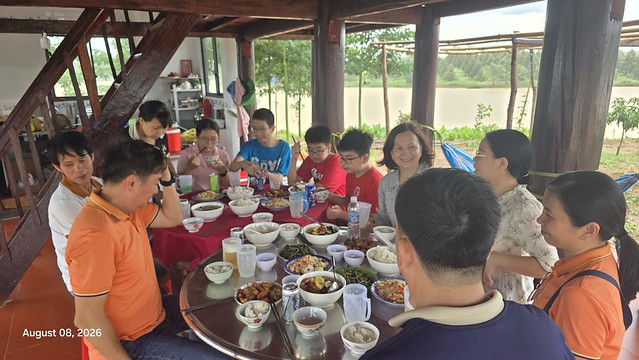
On the table were things that felt unmistakably “Thiên Ưng Phủ”: cashews harvested on the farm, durian freshly picked from Uncle Út Len’s place, lăng fish caught in the lake by Mr. Ba Huân, and a jar of rice wine brought over by our neighbour Mr. Bình.
After dinner came music and performances. No large stage. No professional lighting. Just karaoke, laughter and people who had been lost together in the forest only a few hours earlier. Yet the atmosphere felt remarkably intimate.
The most memorable performance was Minh Nguyệt’s Cửu Vạn Tự dance. Strong, decisive turns in the darkness among the trees seemed to give the whole space a different rhythm.
After the performances came an astronomy workshop. August was cloudy, so the telescope could not be used as planned. I used three portable projectors to turn the walls into a three-dimensional environment, bringing the Moon, Mars, Jupiter, Saturn and nebulae before everyone’s eyes one after another.

Bon and Bi, Tuấn’s children, unexpectedly became two “young astronomy experts”, repeatedly answering difficult questions correctly. The night deepened. Insects chirped. Wind moved through the canopy. Everyone quickly fell asleep.
A Morning That Makes You Want to Stay Forever
At exactly six on Sunday morning, I stepped outside and found Gulnur already waiting in the rest pavilion. She had remembered what I promised the day before: that I would teach her a meditation technique that morning. We carried mats to the lakeside, faced the rising sun and practised breathing and meditation.
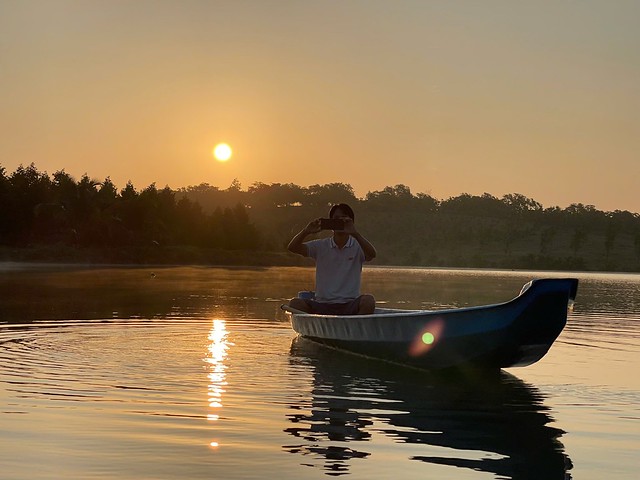
That morning was unusually beautiful. Flocks of birds crossed overhead. White and yellow butterflies fluttered around the grass. On the surface of the lake, small circles kept spreading—signs of large fish moving below.
The wind was very light. Meditation music blended with birdsong and the sound of water.
When the practice ended, Gulnur sat quietly for a moment and then exclaimed, “Oh my God, I want to stay here forever.”
I laughed. “This is not even the most beautiful season.”
In March, April and May, the lake is clear and green like jade. Thiên Ưng Phủ glows red with ripe cashew apples. When the wind passes through, the fruit drops to the ground with soft thuds, and the next morning the children need only take baskets out to collect it.
In the dry season, the night sky is crystal clear. Thousands of stars are visible to the naked eye. On particularly fine nights, even the Milky Way can be seen.
Gulnur nodded. “I and many Russians will come back here.”
The morning continued with coffee in the stilt house, then a visit to Ms. Hòa and Mr. Bình for tea, flowers and fruit, before we returned to the swimming area.

Gulnur could not swim. At first she stayed close to the bank in a life jacket. But after watching the children play freely in the water, she decided to try. She was frightened for the first few minutes, then gradually became more confident. In the end, cheered on by everyone, she held onto a float and crossed nearly 200 metres from one bank to the other.
“The water here is so warm!” she shouted happily.
Everyone laughed. Vietnamese people usually enter a lake and praise how “cool” the water feels. A Russian visitor was delighted because it felt “warm”. A single sentence was enough to show how different the climates we came from were.
But our adventure with the forest was not yet over.
Second Entry into the Forest: Tà Thiết
At eleven, we had lunch and then left for the forest at Tà Thiết.
If the previous day’s forest visit had felt spontaneous, instinctive and slightly reckless, Tà Thiết was entirely different.
This was a forest with memory. A forest that had witnessed history. And a place where, I believe, any visitor from afar would eventually have to say: “Wow!”
Tà Thiết is a Special National Historical Site. Admission costs only 20,000 đồng, with electric carts and guides taking visitors to the main points of interest.
When Gulnur heard that the price converted to less than one euro, she was amazed. “Oh my God! Life in Vietnam is wonderful!”
I explained that this is a “red address”, a site intentionally made accessible so that many people can learn about history. Our first stop was the memorial house.

In that solemn space, stone plaques bore the names of generals associated with the Tà Thiết base: General Võ Nguyên Giáp, General Văn Tiến Dũng, General Lê Đức Anh, General Nguyễn Thị Định, General Hoàng Anh Thái, General Lê Trọng Tấn, and others.
After offering incense, we boarded the electric cart. The forest began to close behind us.
The Great Forest
The narrow road ran deeper and deeper into green. On both sides, trunks rose so high that to see their crowns you had to tilt your head all the way back.
Only a few narrow shafts of midday sunlight could reach the ground. Most of the forest remained in a deep green light, at once shadowed and solemn. The air was noticeably cooler.
From time to time the cart crossed a small clearing, but only seconds later walls of vegetation closed around us again. Then the ancient trees began to appear.
Cám. Kơ nia. Sến. Bằng lăng.
Names that had previously been only words now stood before us as gigantic trunks that several people joining hands might still fail to encircle.
Standing beneath them, everyone naturally lowered their voices. No one had to ask. Perhaps before living beings that have stood for hundreds of years, people instinctively feel that they are only passing guests.
What astonished the group most was the meeting hall used by the liberation forces. Directly in front of it stood an enormous móng bò vine.
I had seen many vines in forests before, but this plant seemed to have moved beyond the ordinary idea of a “climber”. Its roots, trunk and huge wooden arms crawled upward, stretched sideways and wrapped around the ancient trees nearby. The intertwined growth formed great arches.
Standing beneath them, we felt as though we had entered a temple built by the forest itself.
Someone said, “It looks just like Avatar!”
In photographs, the scene really did look almost unreal.

But the forest still had more surprises.
A Buddha Formed by Nature
The electric cart took us to another stele house. At the entrance stood a termite mound about three metres high. At first no one said anything. Then one by one we began to recognise the same image.
A round head. Full cheeks. A protruding belly. A face that seemed to be smiling.
The termite mound had an uncanny resemblance to a giant Maitreya Buddha. The whole group fell silent.
It may have been nothing more than a coincidence of nature. Yet in an ancient forest, beside the path into a memorial house, the shape created a very particular feeling.
Each person lit a stick of incense inside the stele house, then quietly wished for peace before the forest’s “Buddha”. Afterward we continued on. At last we reached the place I had most wanted to see.
The Mango Tree that Touches the Sky
It was an ancient mango tree more than 200 years old. I had heard local people call it the largest mango tree in the world. I would not make that claim myself. I had previously looked up famous mango trees in India, Africa and the Americas, some with canopies of astonishing breadth.
But the mango tree at Tà Thiết is impressive in a different way: it is extraordinarily tall.
Its trunk rises like a giant column and disappears into the canopy above. Looking up from the ground, its exact height is hard to judge, but it feels as though it could reach several dozen metres.
The guide said that around 30 April and 1 May each year, the mangoes ripen. Fruit covers the ground. Wild animals come to eat it. Visitors pick up and eat the fruit, yet there is still more than enough.
All eight of us joined hands around the trunk. We were preparing to take one final photograph and leave the forest when suddenly—a fierce cry tore across the space.
Everyone spun around. The call echoed from one corner of the forest, so loud and strange that it sounded like a group of animals fighting.
Tuấn said, “Maybe gorillas are fighting!”
No. Another call came. Deep. Resonant. Almost like a brass horn sounding in the forest.
The children stopped laughing. For a moment, a chill ran down my spine as well. What if it was a large animal?
The guide remained completely calm. He smiled. “It’s nothing. That’s a ‘ground phoenix’.”
A ground phoenix? He explained that it was a hornbill, a large and distinctive forest bird.
We were still looking around when Gulnur suddenly shouted, “Look up on that branch!”
Everyone looked up together. There it was: a large bird perched high on a branch in front of us.
Its enormous bill was so prominent that it seemed almost out of proportion to its body. It tilted its head and looked down at the group, showing no sign that it wanted to leave.
The guide laughed. “There! We only just mentioned it and it appeared. It loves playing basketball with visitors.”
He took a sweet and tossed it upward. The hornbill stretched its neck. Missed.
“No basket!”
The children immediately joined the game. Bi threw. Bon threw. Cua threw. Ghẹ threw. Every piece fell to the ground. The children protested: “This bird is so lazy! You have to throw it right into its mouth before it will eat!”
I laughed. “Watch me.” I picked up a chestnut.
Instead of throwing it directly at the bird, I tossed the chestnut almost vertically so that at the top of its arc it nearly paused in front of the huge bill.
The hornbill only had to stretch its neck slightly. “Tok!” The chestnut landed neatly in its beak. It shook its head and swallowed. “Kek! Kek!”
Everyone applauded. “Teacher Vũ got the ball in the basket!”
Laughter rang between the ancient trunks. Only a few minutes earlier, the bird’s cry had frozen everyone with fear. Now it had become the star performer in our farewell to the forest.
The electric cart began taking us back out. The hornbill hopped to another branch, then flew alongside us for a short distance.
I turned to look back. Behind us, the great forest of Tà Thiết slowly closed again.
Twice across the Boundary of the Forest
In two days, we had entered the forest twice.
The first time, just across the lake from Thiên Ưng Phủ, we entered with the curiosity of people on an outing. Only a few dozen minutes later, the forest taught us humility: no paths, no signs, and every familiar human sense of direction capable of disappearing almost at once.
The second time, at Tà Thiết, we entered a forest carrying both the power of nature and the memory of history. There were ancient trees too large for several people to encircle, vines forming a “temple” in the great forest, a termite mound shaped like Maitreya Buddha, a mango tree more than two centuries old, and finally the fierce call of a hornbill from deep inside the canopy.
Two forests. One made us lose our way. One made us reluctant to leave.
But both reminded us that nature is most beautiful not when it has been arranged to serve people, but when people are permitted to enter it as guests.
Until Another Season
On the way home, the children were already talking about the next visit.
In November and December, the rubber forests in this area enter their leaf-changing season. The whole region turns yellow and red, and some roads look like European autumn. The air becomes cooler. Clear, cloudless nights are also excellent for observing winter constellations.
After returning home, Gulnur sent us a message: “I spent only a few days in Vietnam, but I feel as though I have gathered several months’ worth of memories. I very much hope you will come to Russia in winter.”
I read the message and remembered my original question: “Beach or tropical forest?”
It was fortunate that she chose the forest.
Had she chosen the beach, we probably still would have had a very enjoyable trip. But there would have been no moment when the entire group stood still in the forest and realised we were lost. No giant trees of Tà Thiết. No temple made of roots and vines. No mango tree more than two hundred years old. And certainly no unexpected “horn” sounding from the great forest, followed by a hornbill appearing on a branch as though it had been waiting there to say goodbye.
Some journeys are remembered because of the places we visited. Others are remembered because of a single moment. For me, this journey is the call of “Mỹ ơi! Mỹ ơi!” in the first forest—and the “kek! kek!” of the hornbill in the second.
One call led us out of the forest. One call made us want to return.