
Green forest leans beneath the lofty sky,
The Đắc Huýt River sings its rustling forest song.
This morning white clouds hover halfway,
Sunlight slips through leaves to greet the birds in flight.
The lake lies still beneath a thousand clouds,
Lotus leaves tremble with drops of water, drunk on the forest’s reflection.
The pines softly call across the layered hills,
Late orchids bloom, their fragrance lingering in the mist.
The river trails like a ribbon of silk,
Embracing ancient roots, mirroring the sky.
Flocks of birds join wing to wing in play,
A shaft of sunlight falls, spilling gold into the afternoon.
An eagle sweeps through the solitary wind,
Its tilted wings shade the water, turning desolation into poetry.
Phương smiles in the wilderness,
A little boat carries the dreams of humankind.
Peace follows the rhythm of the waves,
Listening as the forest tells stories from the world’s first dawn.
The moon rises; firelight sings and shimmers,
A thousand trees breathe in rhythm with us.
O forest—vast music without end,
Calling us back, so we may find ourselves.
River, wind and wing of bird,
Keep safe the breathing heart of the great forest.
“The forest is not silent—the forest tells stories, remembers, loves...”
A Traveller’s Confession
The poem “Whispers of the Great Forest of Bù Gia Mập” is a gentle green piece of music, where every sound of forest, river and wind merges into the breathing of earth and sky. When I wrote it, I did not think of myself as composing. I was simply listening to the forest speak. Every leaf, every drop of water, every bird in flight was a whisper, and I was only the one who wrote it down. In the morning mist I saw the forest leaning into its own reflection, heard the Đắc Huýt River singing a melody soft as silk, and watched the sky gaze at itself in the still surface of the lake. The beauty of Bù Gia Mập is never ostentatious. It seeps quietly into each breath until the traveller’s heart seems to dissolve into the forest’s humid air.
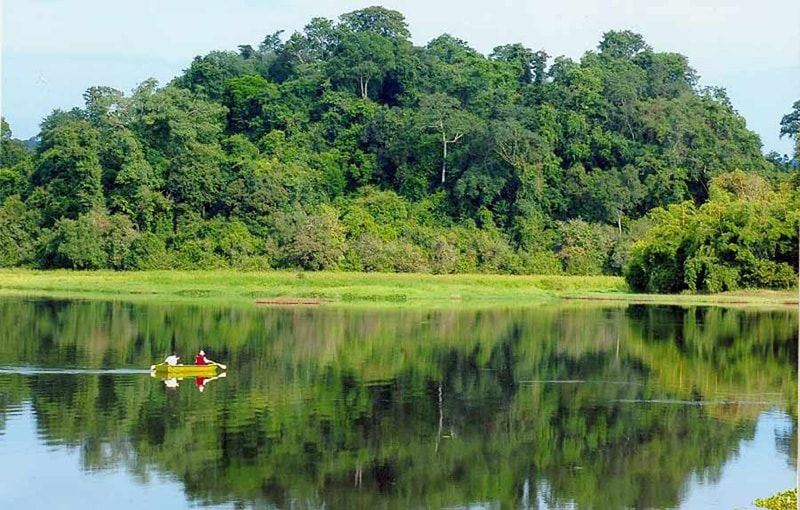
As the small boat gently parted the water, the river opened ahead like a ribbon of green silk, delicate yet endless. In that vast forest, a human being suddenly feels astonishingly small—and at the same time infinitely free. I watched ancient trees cast their shadows on the river and birds wheel through the sunlight, and understood that every living being has a soul, each singing in a language humankind forgot long ago. Perhaps that is why, amid the rustling wind, I found my own heart becoming strangely quiet. The boundary between myself and the forest, between human and earth, disappeared. There remained only a shared breath—slow, deep and warm.
In the poem, the little boat is more than a means of travel. It is a symbol of the soul’s journey. It carries me through veils of mist, through the call of water, through moonlight shimmering across leaves, and finally carries me home to myself. Each wave against the hull, each faint touch of wind on the skin feels as though it is washing away the dust of ordinary life and clearing the mind. To me, Bù Gia Mập is not simply a forest. It is sacred ground, a place where one can rediscover a primal peace—the peace that noisy modern life took from us long ago.
I love those moments when the moon rises and firelight filters through the leaves, when human shadows and tree shadows merge. In the stillness of the night forest I feel that I can hear the heartbeat of the earth, the pulse of countless living things in motion. The forest is not silent—the forest tells stories, remembers, loves. I sit there without needing to say anything, only listening, only feeling. And in such moments I understand why human beings need nature so deeply. Not to conquer it, not to possess it, but to see ourselves reflected there and remember that we were never separate from the forest in the first place.
“When I wrote the final lines of the poem, I wanted to preserve that moment—a moment in which human beings, earth and sky breathe in the same rhythm. I wanted readers, too, to hear the ‘whisper’ I once heard in the Bù Gia Mập forest: not loud, not violent, only the wind moving through branches, water tapping the side of the boat, and the human heart dissolving into nature.”
The poem is a word of thanks, a slight bow before the enduring beauty of Mother Earth. In a world that changes day by day, there is still a place that reminds us that if we simply let ourselves enter the forest, we may return to ourselves—whole, clear and free as at the beginning.